Yamanote Line rent by station, July 2026: comparing all 30 stations at 25m²
Treating the Yamanote Line as one rental market hides a large difference between stations. With size, age and layout held constant across all 30 stations, the highest and lowest estimates are still about ¥68,000 apart each month.
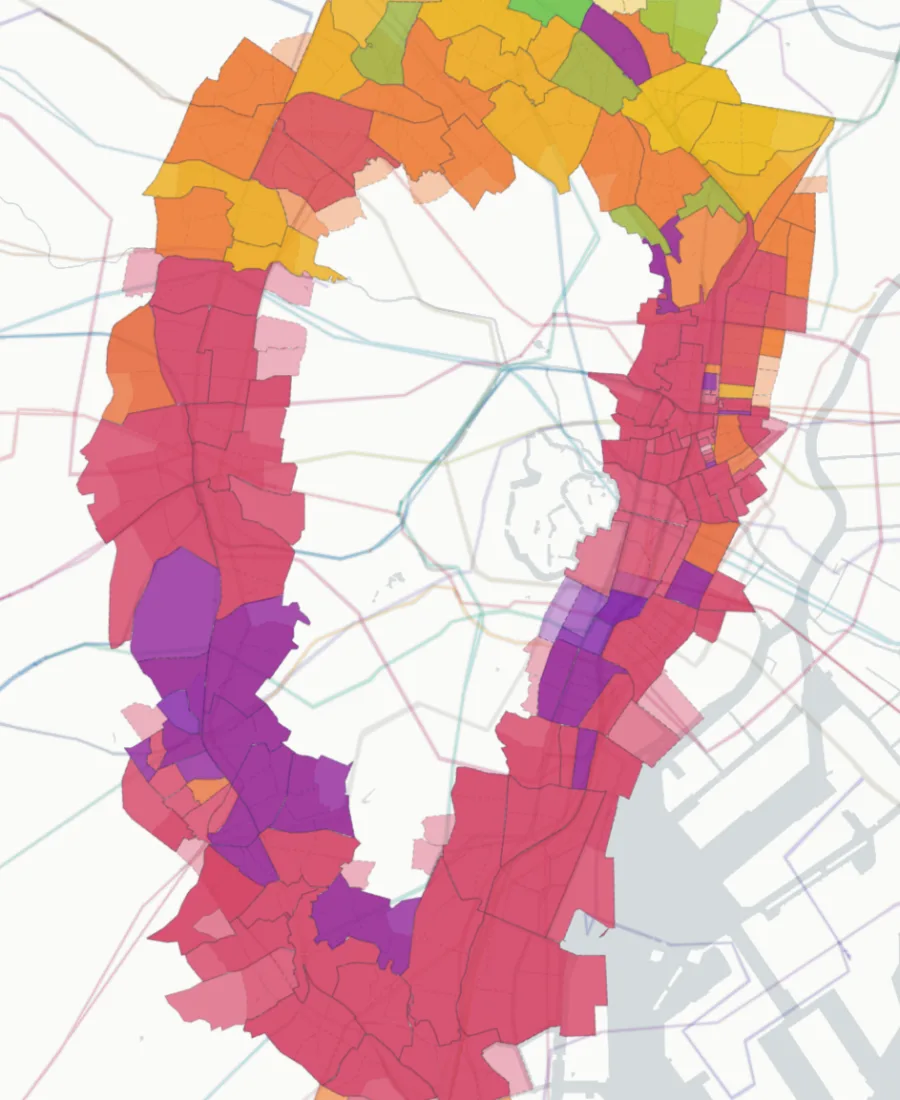
Rents are highest in the southwest and lower in the northeast
Shibuya has the highest estimate at ¥169,303 a month. Harajuku follows at ¥160,854, then Ebisu at ¥160,634. Tabata is ¥104,988 and Yurakucho is ¥101,533. The gap between the highest and lowest estimates is ¥67,770, or about 66.7%.
Estimated rent at all 30 Yamanote stations
The stations below follow the outer loop from Tokyo Station. A number means the rent calculation used records from that station. "No records from this station" means the estimate depends more strongly on nearby areas and the pattern across the line.
| Station | Estimated rent for 25m² | Records used | How it was calculated |
|---|---|---|---|
| Tokyo | ¥130,753 | No records from this station | Calculated from nearby rents |
| Kanda | ¥133,336 | 1,866 | Records from this station |
| Akihabara | ¥132,353 | No records from this station | Calculated from nearby rents |
| Okachimachi | ¥124,895 | No records from this station | Calculated from nearby rents |
| Ueno | ¥119,294 | 3,763 | Records from this station |
| Uguisudani | ¥111,329 | 10,528 | Records from this station |
| Nippori | ¥105,405 | No records from this station | Calculated from nearby rents |
| Nishi-Nippori | ¥105,405 | No records from this station | Calculated from nearby rents |
| Tabata | ¥104,988 | 6,693 | Records from this station |
| Komagome | ¥110,004 | No records from this station | Calculated from nearby rents |
| Sugamo | ¥112,028 | 5,106 | Records from this station |
| Otsuka | ¥113,568 | 930 | Records from this station |
| Ikebukuro | ¥124,351 | No records from this station | Calculated from nearby rents |
| Mejiro | ¥114,636 | 2,892 | Records from this station |
| Takadanobaba | ¥123,381 | No records from this station | Calculated from nearby rents |
| Shin-Okubo | ¥131,268 | 888 | Records from this station |
| Shinjuku | ¥138,370 | No records from this station | Calculated from nearby rents |
| Yoyogi | ¥150,316 | 3,029 | Records from this station |
| Harajuku | ¥160,854 | 208 | Records from this station |
| Shibuya | ¥169,303 | 4,368 | Records from this station |
| Ebisu | ¥160,634 | 9,574 | Records from this station |
| Meguro | ¥139,902 | 11,607 | Records from this station |
| Gotanda | ¥141,817 | 5,297 | Records from this station |
| Osaki | ¥133,521 | 2,764 | Records from this station |
| Shinagawa | ¥148,489 | No records from this station | Calculated from nearby rents |
| Takanawa Gateway | ¥139,295 | No records from this station | Calculated from nearby rents |
| Tamachi | ¥137,416 | 1,288 | Records from this station |
| Hamamatsucho | ¥148,861 | No records from this station | Calculated from nearby rents |
| Shimbashi | ¥152,062 | No records from this station | Calculated from nearby rents |
| Yurakucho | ¥101,533 | No records from this station | Calculated from nearby rents |
The count shows how many records were used in the station's rent calculation, not the number of unique homes. No records from this station means the estimate depends more strongly on nearby areas and the pattern across the line.
The median estimate for a 25m² home along the whole line is ¥132,353. That is 7.5% above the Tokyo average. But the extra cost is not shared evenly by every station. The line has clear peaks and dips.
The curve is easier to read in three parts
From Osaki to Shibuya, the estimate climbs from the ¥130,000 range into the ¥160,000 range. Gotanda and Meguro sit close together before Ebisu, Shibuya and Harajuku form the main peak. Shibuya is ¥36,950 above the line median and ¥64,315 above Tabata.
From Shinjuku to Tabata, the curve moves down from roughly ¥140,000 toward ¥100,000. It passes Takadanobaba, Mejiro, Ikebukuro, Otsuka, Sugamo and Komagome before reaching Tabata. The difference between Ebisu and Mejiro is ¥45,998 a month. If both stations still give you a workable journey, that gap is large enough to change the housing budget.
From Ueno to Tamachi, the line does not follow a simple direction. It passes Okachimachi, Akihabara, Kanda and Tokyo before falling sharply at Yurakucho, then rising again at Shimbashi and Hamamatsucho. Yurakucho and Hamamatsucho are close, yet their estimates differ by ¥47,328. Yurakucho has no station-level count, so this result needs extra care.
A railway-line name is not a price
The expensive stretch around Shibuya, Harajuku and Ebisu also has other railway connections, dense shopping and entertainment, and costly addresses. In the north, Tabata, Sugamo and Otsuka cluster closer to ¥110,000. That is a meaningful saving for someone who can move a few stops without making the commute difficult.
Yurakucho needs a little caution. We found fewer nearby rental adverts there, so its estimate depends more heavily on surrounding areas. Think of the chart as a way to compare possible stations, not as a quote for a particular flat.
| Station | Estimated rent for 25m² | Position |
|---|---|---|
| Shibuya | ¥169,303 | Highest |
| Harajuku | ¥160,854 | Second |
| Ebisu | ¥160,634 | Third |
| Line median | ¥132,353 | Whole line |
| Tabata | ¥104,988 | Lower end |
| Yurakucho | ¥101,533 | Lowest, surrounding-area estimate |
These are estimates for comparison, not the advertised rent of a particular home.
Why compare a fixed 25m² home?
A simple average would make stations with more large homes look more expensive. Fixing the size at 25m² gives us one common measuring stick. It is also easy to imagine as a home for one person.
It does not mean a 50m² home should cost exactly twice as much. Larger homes come with different layouts and building types, and rent per square metre can change with size. If you need a home for two people or a family, use this chart to understand the broad station pattern, then repeat the comparison with the layout you actually need.
The word "estimated" matters too. The figure is not the rent of one real flat waiting beside that station. It is a comparison value calculated from nearby adverts after allowing for differences in size and location. A month with many new-build adverts, or a station with very few adverts, can sit away from what you find in a live search.
A five-minute walk and a fifteen-minute walk are not the same market
When comparing stations, keep walking time similar. A flat five minutes from Shibuya and one fifteen minutes away can have different surroundings and even a different practical railway entrance. A home between two stations may also be listed under a different nearest station depending on the property website.
The Yamanote Line is surrounded by subway and private railway connections. Ebisu also has the Hibiya Line. Shibuya has several subway and private lines. Meguro connects to the Namboku and Mita lines. Part of the rent difference therefore pays for all the journeys available around the station, not just the Yamanote train itself.
Search with pairs of stations, not one fixed name
Choosing one station at the start makes the whole search depend on that station's price level. Comparing two or three stations with similar travel times gives you more room.
- If you need Shibuya or Ebisu, also compare Meguro, Gotanda and Osaki.
- If you need Shinjuku, look north toward Mejiro, Otsuka and Sugamo, then compare the extra travel time with the monthly saving.
- If you need the Tokyo Station area, search Kanda, Yurakucho and Hamamatsucho with the same conditions and check how many adverts support each result.
The goal is not to find the cheapest station. Put travel time, transfers, walking time and monthly rent beside each other. A ¥30,000 monthly gap becomes ¥360,000 over a year. You can then ask whether the extra minutes of travel are worth that amount to you.
What this chart cannot decide
Building age, equipment, floor level, noise, sunlight and management quality are not shown in the line. Homes beside the tracks, on a main road and in a quiet residential street can have different rents even when the station name is the same. Management charges and renewal fees can also change the real monthly or yearly cost.
The station estimates are not a forecast of future rent. They compare the adverts we could observe. Use the curve to widen your station shortlist, then compare real adverts during the same week before making a decision.
Move from the line name to the stations
Property searches often use "Yamanote Line" as a single condition. The data shows why the next step matters. If your commute still works, moving the search by a few stations can change the monthly budget without leaving the same line.
A good order is to read the peaks and dips, choose about three possible stations, then search those stations with the same layout, building-age range and walking time. Add management charges before comparing the final monthly cost. Moving from the whole line to stations and then to individual homes keeps the chart useful without asking it to do more than it can.
The Yamanote station rent map lets you compare the map and station order together. Start with the line, then check the stations that fit your journey.